
This is an old revision of the document!
Table of Contents
Plastic Surgery Hand/Extremity Service
Service Pearls
Team Members
Attendings: Drs Mickey Gordon, Matthew Iorio, Kia Washington, Mark Greyson
PA: Amy Kelso, Ben Nigg
Residents: This service is comprised of a Chief Resident and junior resident. There is no intern on this service.
Pager:
- 6a-6p: 303-266-0035
- There is also a consult pager you need to carry when on call that is NOT forwarded to x0035 during daytime hours. At 6pm, all consults are forwarded to x4354.
- 6p-6a & Weekends/Holidays: Plastics Service Pager (303-266-4354)
PA Contact Info:
- Amy Kelso: (719) 671-9156
- Ben Nigg: (319) 471-5846
Weekday Consults
- The most junior resident on service is responsible for consults and service pagers. Amy and Ben (PA's) help to see consults when residents are in the operating room or occupied with other service/educational obligations. NB: Amy/Ben do have her own clinics and helps cover cases and clinic off-campus, so some days may not be immediately available to help.
Scheduling Follow-up Appointments
- Consult patients should be added to the “Plastics Hand” shared Epic list upon receipt of the consult.
- If the patient will need a follow up appointment in the Hand Clinic, please make sure the ED puts in an order for “ambulatory referral to Hand Surgery” and specifies the attending who is on call that day. This is the same attending to whom your note should be routed. Add the patient to the “For Hand Clinic Follow-up” shared Epic list and send a staff message to: P SP AMC HAND SURGERY (pool) and cc: the attending, Amy Kelso PA-C, Benjamin Nigg PA-C, Dan Rodgers, etc.
- If the patient will need a follow up appointment in the Plastic Surgery Clinic, please send a staff message to: P SP AMC PLASTIC SURGERY (pool) and cc: the attending, Amy Kelso, Benjamin Nigg, Kristine Padiernos.
- If patient is an EXTREMITY patient (Greyson/Iorio) and discharging with WV in place, please cc “Stephanie Boyd” on follow up email so that she can help coordinate any home or follow up needs.
Clinic
- Gordon: Monday afternoons, Wednesday mornings, and Friday afternoons. He writes his own notes
- Iorio: Tuesday mornings and afternoons. Fast-paced. Amy and Ben are sometimes there to help.
- Washington: Wednesday afternoons. She expects help.
- Greyson: Wednesday mornings and afternoons. Uses his own smart phrases, make sure to familiarize yourself with them before going to clinic.
Surgery
- Gordon: Monday mornings, Wednesday afternoons and Friday mornings.
- Iorio: Every Thursday. Mondays and Fridays may be hand cases or Plastics cases. Fast-paced. Have Preop orders and discharge orders in the night prior to facilitate turnover
- Washington: Mondays are split between UCH and CCNSC. Operative days off campus are covered by Amy.
Procedures
- Dr. Washington does wide awake procedures in the Spine Center 2 every other Wednesday
- Expectations: resident/Amy consents, marks, and blocks the patients in Preop holding
- Nursing staff does discharge paperwork
Hand Therapy
- Hand Therapy is an integral part of any successful hand surgery both pre and post-operatively
- Below is a simple reference for hand therapy protocols and what the hand therapist will provide to our patients
- Hand Therapy Guidewhat_is_hand_therapy_-_resource_for_cu_residents_2.23.21.docx
Postoperative Discharge Instructions
Instructions for After Your Hand Surgery
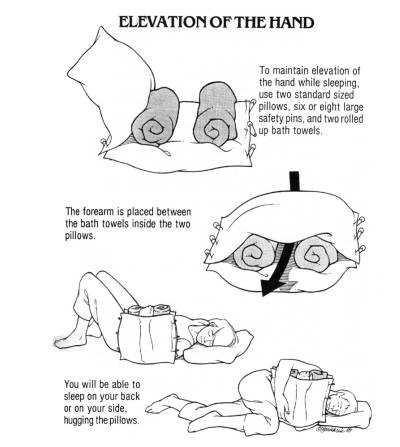
- The most important thing you can do to relieve discomfort and promote the healing of your wound is to keep your hand above the level of your heart at all times. This helps reduce some of the swelling that occurs because of the surgery. With the swelling decreased, you will have less throbbing pain. It also improves conditions for more rapid healing of the wound. You will need to keep your hand elevated above your heart for at least a week or until you return for your outpatient visit.
- In almost all cases, DO NOT use your hand for ANY activity. This includes everything from brushing your teeth to feeding and dressing yourself. Using your hand only worsens the swelling (which increases your pain and slows the healing process). Unless you are specifically told to do something, you are expected not to use your hand at all until you return for evaluation during your outpatient visit. You may be asked to wiggle your fingers after surgery, but this would NOT include performing any activity with your hand.
- Pain should be expected after your surgery. How much pain a patient has varies from person to person and from procedure to procedure. The important thing to remember is that pain is not helpful. Experiencing pain will not improve the healing of your wound in any way. Therefore, please take your pain medication as directed. Take the medicine BEFORE it hurts a lot. If you wait, the medication usually will not work very well. Experiencing a lot of pain does not help the healing process.
- If you have a hard splint or cast, please keep it on your hand in place until your return for your outpatient visit. If you want to take a shower, use a plastic bag (a newspaper bag seems to work quite well) to cover your splint/cast. If you have a soft dressing, you may remove it after 5 days and begin washing the wound daily with water and placing a dressing to keep the wound clean.
- Occasionally patients are given antibiotics to take after surgery. This does not happen very often, but if you are given such a medicine, please take all of them exactly as directed.
- In winter, when the weather is very cold, keep your hand covered to prevent it from getting cold. This can be done by wrapping it additionally with a towel, sweater, coat or anything else that will protect it. Elevation of the hand at night Elevating your hand at night is just as important as elevating it during the day. As much as you can, try to keep your hand elevated above your heart. The following pictures show one way that might work, but there are many other ways to do this (such as sleeping in a lounge chair with the hand elevated on pillows or blankets). Use whatever works for you.

Pain Control: Elevate and apply ice to your forearm for relief of throbbing pain and swelling. You may move your fingers as the splint allows. For mild to moderate pain, alternate OTC NSAIDs and Tylenol every 3 hours as instructed below. For pain not relieved, you may take XX every 4-6 hours as needed for severe pain.
- 8am: 500 mg Tylenol
- 11am: 600 mg Ibuprofen
- 2pm: 500 mg Tylenol
- 5pm: 600 mg Ibuprofen
- 8pm: 500 mg Tylenol When to Call your Doctor If you experience any of the following, call your doctor: *Severe or increasing pain. *Cold, pale, or numb fingers. *A fever over 101°F. for over 4 hours, redness of your incision, or a bad odor from your dressing. All of these symptoms might indicate an infection. If you have any questions that concern you regarding your surgery or something that has happened since the surgery, do not hesitate to call. If it is something that will keep you awake at night worrying about it, it is better to call even if it is after hours. It might take a bit longer to get your questions answered after hours, but if it helps you to get a better night of sleep, you will benefit from the extra effort. During regular hours, call the regular office number at 720-848-0485 and select the nurse option line. One of the nurses will try to get back to you as soon as they possibly can. After hours, call the main hospital at 720-848-0000 and ask for the resident on call for Hand Surgery. Wait on the phone while the operator pages the doctor.
Other important numbers:
- Clinic appointments 720-848-0485
- Occupational Therapy 720-848-2000
Prescriptions given: XX
Next Appointment: XX
Postoperative Protocols
Flexor Tendon Repair - Early Active Motion Protocol
Immediate Post-Operative Period:
- Immobilization for the first 3-5 days post-operatively in a surgical splint with the wrist in 10-30 degrees of extension, MPJ at 30 degrees flexion and IPJ in full extension.
- Patients are instructed to not move the fingers at all and to keep the hand elevated at all times in these early postoperative days to avoid bleeding into the wound. Bleeding causes clotting, and clotting becomes scar. Waiting 3 to 5 days before moving lets the swelling, work of flexion, and friction decrease to minimize the risk of rupture. Collagen formation does not start until day 3, so detrimental immediate movement is not necessary.
3-5 Days Post-Op – 2 weeks Post-op:
- Placement into a forearm-based dorsal block splint with wrist in 10-30 degrees extension, MPJ in 30 degrees flexion and IPJ into full extension.
- Edema control through elevation of the hand and gentle wrapping with Coban between exercises and at night
- TAM measurement
- Within the dorsal blocking splint, patients are taught the following 3 exercises at 25 repetitions every waking hour: (no tension, painful or forceful movement) “You can move it but you can’t use it” should be emphasized several times at each visit.
- Passive flexion of all digits as a “warm-up” before active flexion
- Active IPJ extension with MP joint blocked in flexion to prevent interphalangeal joint flexion contractures
- True active flexion up to 1/3 to 1/2 of a fist, initiating movement at the DIPJ (active hook fist)
2-4 Weeks Post-Op:
- Dorsal block splint is shortened to a hand-based Manchester orthosis
- Continue use of Coban between exercises and at night
- Scar massage as needed
- TAM measurement
- Patients are instructed to complete the exercises below at 25 repetitions every waking hour:
- Continue passive flexion of all digits,
- Continue active IPJ extension with MP blocked in flexion,
- Continue true active flexion ½ to full active fisting and up to 45 degrees of wrist extension, working toward full active fisting by 6 weeks post-op
- Add active synergistic exercises in the Manchester orthosis
4-6 Weeks Post-op:
- Continue use of hand-based Manchester orthosis
- Continue use of Coban between exercises and at night
- Scar massage as needed
- TAM measurement
- Continue the following at 25 repetitions every waking hour:
- Passive flexion of all digits,
- Active IPJ extension with MP blocked in flexion
- Active flexion ½ to full active fisting and up to 45 degree of wrist extension, working toward full fisting by 6 weeks post-op
- Active synergistic exercises in the Manchester orthosis
6 Weeks Post-Op:
- Manchester short orthosis is discontinued
- Scar management as needed
- TAM measurement
- Patients can start to use the hand for light activity
- Start palm-based or digit extension splinting at night if needed to correct IPJ flexion contracture
- Relative motion flexion orthosis during daytime activity may be used to regain active flexion
- Relative motion extension orthosis may be used to address PIP flexion contracture
8 Weeks Post-op:
- TAM measurement
- May begin strengthening
Mallet Finger Protocol - For Hand OT
I have created a smart phrase for a referral to Hand Therapy for Mallet fingers. To make it simple, just type Mallet and then insert it in your referral. (full name is Malletprotocol).
Our protocol is to apply quikcast material with the DIP in hyperextension. We follow up in 5-7 days to recheck as edema reduces pretty quickly and the cast becomes loose.
We will reapply and follow up every 10-14 days for skin checks, compliancy and integrity of the cast.
At 6 weeks of immobilization for bony mallets, it is helpful to have a return MD visit for xray to ensure that AROM is appropriate at that time. If it is, we begin with gradual AROM of 25 degrees, increasing this weekly. We use dynamic tape under the cast and during AROM ther ex to limit ext lag, or sudden flexion and to assist in Active extension in the early weeks of AROM.
For tendon lacerations, we begin the same AROM protocol at 8 weeks.
Patients are followed up weekly for AROM advancement and to assess for lag. They wean out of their splints gradually beginning the second week of AROM. They wean out of night splints around 4-6 weeks after beginning AROM.
Those of us therapists who have used this protocol (dynamic tape and quikcast, with weekly follow up) have found a much better return to full use with very minimal lag. I think this is because we follow up fairly frequently and can modify use of the uninvolved fingers, e.g., if patients report they are still forcefully gripping, or that the splint doesn’t fit as well as when first provided.
These splints tend to stay on well, control edema during the initial healing process and are more streamlined than the typical plastic splints.
There are exceptions: Extreme ecchymosis, edema or open wounds, etc, we will continue to use plastic splinting until the finger can tolerate the quikcast.
Resources for Cross-Cover Interns
The in-house University intern covering the Plastic Surgery Service on nights, weekends, and holidays is always first call for Hand consults whenever there is a Plastic Surgery attending on call for Hand (approx. 4 weekdays/month and 3 weekends/month.).
- The schedule identifying the days that Hand consults are covered by Plastics can found on AMION under the Plastics and Hand call schedules.
- The intern should see the consult immediately, get the history, perform an exam, and then promptly contact the on call Plastics resident for further instruction.
- If for some reason the intern has not been able to reach anyone, the intern should contact the on call attending directly, rather than sit on an unstaffed consult.
- It’s always better for the on call resident to be notified of a consult sooner rather than later.
- Consult patients should be added to the “Plastics Hand” shared Epic list upon receipt of the consult. (If you do not have access to this list, ask one of the residents to add you.) If the patient will need a follow up appointment in the Hand Clinic, please make sure the ED puts in an order for “ambulatory referral to Hand Surgery” and specifies the attending who is on call that day (Dr. Gordon, Dr. Iorio, or Dr. Washington). This is the same attending to whom your note should be routed.
- After a consult is completed and discharged from the Emergency Room, add the patient to the “For Hand Clinic Follow-up” shared Epic list and send a staff message to: P SP AMC HAND SURGERY (pool) and cc: the attending, Amy Kelso PA-C, Janessa Denman RN, and Dan Rodgers, ATC.
Pearls for Common Calls
- Always get a sensory/motor exam prior to local anesthesia
- Discuss oral and IV pain control with ED
- Know how to perform a digital block and a hematoma block
Infections
- Obtain a detailed history (including rapidity of onset and progression)
- Examine for fluctuance
- Give a dose of antibiotics (Get culture first if possible and if necrotizing soft tissue infection is not suspected)
- Supplies needed for I&D:
- - 1% lidocaine with epi
- - ED I&D kit
- - Culture swabs
- - ¼ inch Penrose drain
- - 1L of NS irrigation with 60cc syringe and luer lock irrigation shield attachment
- - Bucket
Lacerations
- Ask about the mechanism
- Make sure tetanus is up to date
- Give a dose of IV antibiotics
- Is there a tendon injury? Determine this by asking the patient to open and close their hand – do the fingers all move normally?
- Is there a digital nerve injury? Determine this by performing a sensory exam on the radial and ulnar border of EACH finger to test the radial and ulnar digital nerves to each finger.
- Is there an arterial/nerve injury at the wrist? Perform a complete sensory and motor exam for the ulnar/radial/median nerves.
- Does the hand appear ischemic? Was there mention of arterial bleeding in the history?
- Supplies needed for repair:
- — 1% lidocaine with epinephrine
- - Betadine
- - Gauze
- - 1L of NS irrigation with 60cc syringe and luer lock irrigation shield attachment
- - Bucket
- - 5-0 nylon sutures
- - 3-0 Supramid or Fiberwire from OR if extensor tendon is involved
- - Suture tray: Hemastat, Needle Driver, Forceps, Scissors (Plastics Minor Set from OR is ideal)
- - Xeroform, 2 inch Kling wrap, Kerlix, Coban
Hand/Wrist Fractures/Dislocations
- For distal radius fractures: Determine if there is an acute carpal tunnel syndrome, meaning, is there numbness in the distribution of the median nerve (thumb, index, long, and radial border of the ring finger)?
- Discuss with ED their ability/availability to perform conscious sedation if needed
- Supplies needed for fracture/dislocation reductions:
- - 1% lidocaine with epi
- - 10cc syringe
- - 18G needle
- - 27G needle
- - Alcohol swabs and Gauze
- - Finger traps and IV pole from ED
- - 4 liters of IVF in bags and surgical netting (for traction weight)
- - Mini C-arm (have the ED call the radiology tech to bring it)
- - Cast cart for cast padding, 4 inch plaster, and 4 inch ACE or Bias
- - Scissors
- - 1L of NS irrigation with 60cc syringe, luer lock irrigation shield attachment, & bucket if open fracture
- - Arm Elevation Pillow from OR (blue foam pillow; need to send OR a patient sticker and go pick it up from the OR desk)
Amputations
- Determine the time and mechanism of the injury
- Make sure tetanus is up to date
- Give a dose of antibiotics
- Determine the level relative to the next more proximal joint (DIP, PIP, MCP – i.e., “the amputation is just distal to the PIP joint”)
- Make sure the part (if available) is wrapped in sterile gauze, placed in a bag, THEN placed in an ice bath
- Have ED perform XRays of both the hand and the amputated finger
- Do not delay contacting Plastics Fellow
- Replants are only done at Denver Health (NOT UCH). If at UCH, will likely perform a revision amputation. Supplies needed are similar to laceration repair above. Get a Minor Hand Tray from the OR for the appropriate surgical instruments.